
Making a Book
And pattern labeling, popsicles, and panic

Happy Monday! In less than four weeks, my new book, The Handsewn Wardrobe, will be out in the world. I’m having trouble making sense of that. I started dreaming up this book in February 2021, and then the ensuing years were a flurry of planning, writing, editing, stitching, fitting, modeling (and recruiting very kind friends and family to model, too), illustrating, and on and on. This spring, I finally emerged from book-making, bleary-eyed and relieved. But of course this book is only just beginning — it will truly come alive in readers’ hands. I can’t wait to see what you make of/from it. Meanwhile, today’s newsletter will tell a bit of the book’s story. I’ll also share my usual ideas for the week, a technical tip, and notes on care.
A Making Story (Part 1)
Usually this section features a sewing project, but this time, we’ll consider the making of a different kind of creature: a book. Perhaps you’d like to write your own someday! Or maybe you’re just a creative person who likes to hear how things are made. Either way, here’s part 1 of the story. (I’ll continue in the next newsletter.)
In late January 2021 — less than a month after releasing my self-published first book, Hand Sewing Clothing: A Guide — I received a query from someone at Storey Publishing asking whether I’d be interested in having a chat sometime and learning more about Storey. As a lifelong craft book enthusiast, I was already familiar with them, and I was honored that they were aware of my work and wanted to have a conversation. So although I was still swamped with work for my first book, I jumped at the opportunity. We had an encouraging video call, and then I started building out an idea for a book proposal.
In my teaching, I’ve noticed how enlivening it is for students to see real-life examples of hand-stitched clothing. It takes the abstract idea of “hand-stitched clothing” and makes it feel very real, very possible. So it felt important to me that someone make a book offering this visual proof of concept. While the first book was a reference/inspiration book, I felt that the world could use a project book to offer beautiful, full-color photographic proof: yes, you really can sew a modern pair of leggings by hand! yes, and a t-shirt too! yes, and a hoodie! and underwear! jeans, jean jacket, button-down shirt, and on and on…
Over several months, and using my notes from Sarah Lohman’s nonfiction book proposal class with Brooklyn Brainery, I wrote up a book proposal for a book with the working title “Clothes of Our Hands.” It would feature 10ish projects, chapter by chapter, plus introductory skill chapters and mini showcases of current modern hand sewists.
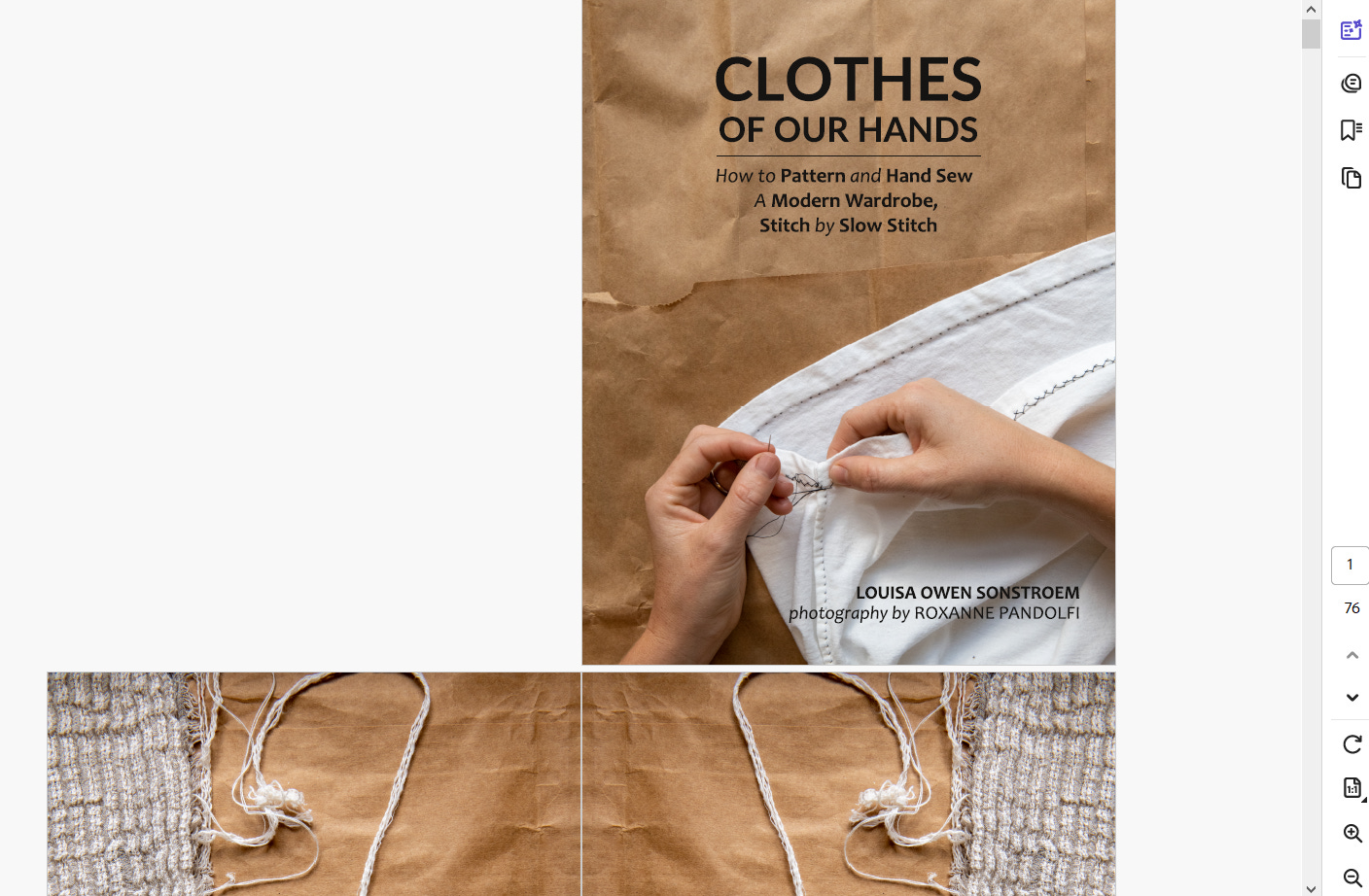
For each project, the book would provide both patternmaking and hand sewing instructions, which readers could use or skip as desired. I paid a photographer friend of mine to take beautiful photographs of some hand-sewn clothing samples I’d made, and included them throughout the proposal. I included a sample chapter (the t-shirt project), as well as discussion of the book’s potential market, promotion ideas, etc., etc. It was the first book proposal I’d had to write, and I was surprised to find that I LOVED writing it! So much fun to dream up a craft book and discuss all of its particulars at length. (And I do mean “at length” — the final proposal included a two-page cover letter, a 39-page proposal document, and a 76-page sample chapter section.)
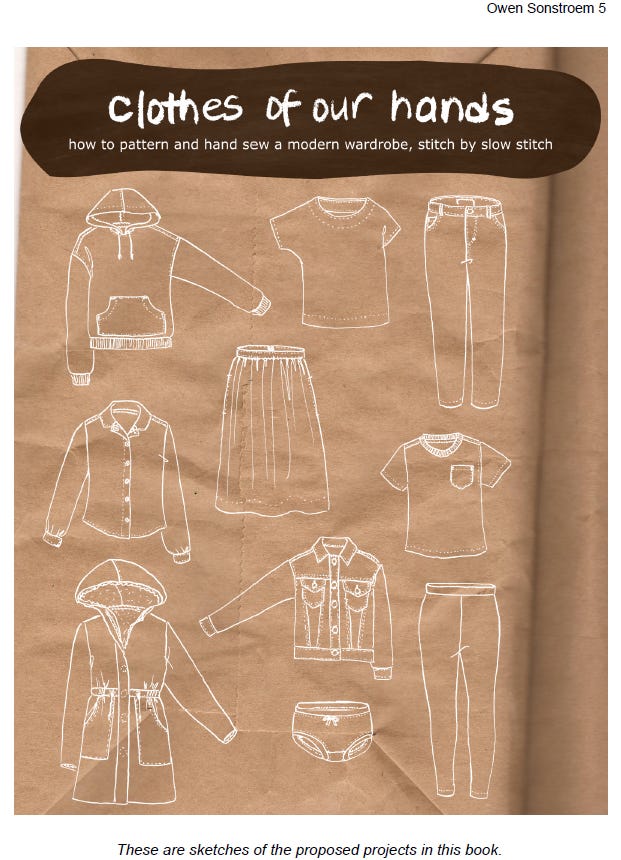
After a few months of waiting for the proposal to be considered by various teams at Storey, I finally got a book offer! (And I want to pause here and point out how very, very different craft book publishing tends to be from, say, fiction publishing. Unlike fiction publishing, I didn’t need to have the entire book written ahead of time, I didn’t need an agent (although you can have one if you want), and the field of submissions was undoubtedly smaller.)
I signed the book deal when I was about five months pregnant. (Would not recommend!) I knew I was signing up for lots of work while growing/birthing/raising a baby, but I figured I’ve juggled lots of hard work before, and surely I’d make it all work somehow.
Ha!
Turns out it takes a whole lot to write a giant book, illustrate a giant book, stitch 17 garments for a giant book, etc., and also birth/raise a small human while dealing with sleep deprivation, postpartum hormones, brain fog, rearranged maternal priorities, a day job, elder care, etc. Again — would not recommend! Writing a book? Yes, absolutely, do it! But don’t take on too much. If I had it to do over, I’d probably write the entire first draft before pitching the book to a publisher. Or at least be sure that my life circumstances would remain stable enough for me to comfortably do all of that work.
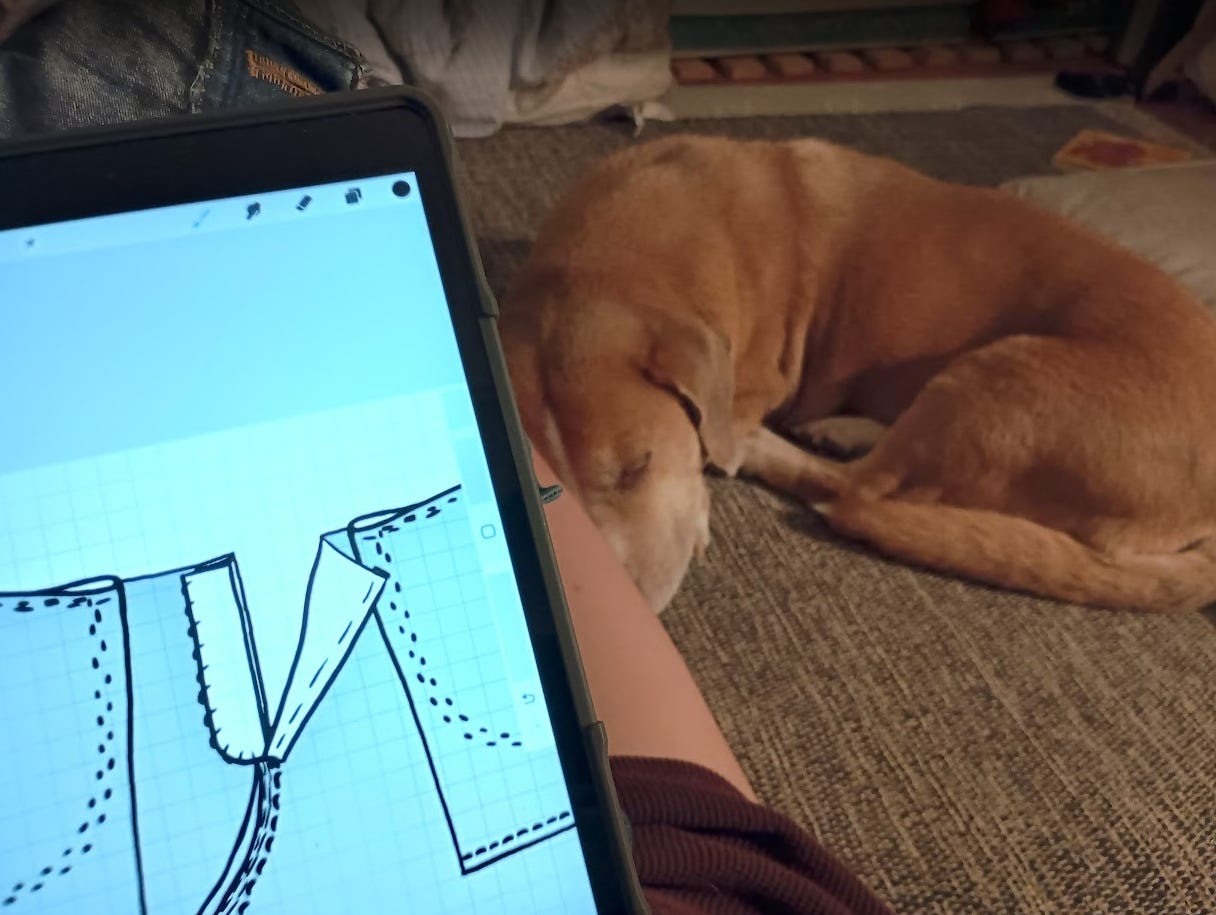
As it was, I made this book during blocks of time gifted to me by my husband, my mother, and my baby. After work but before taking over with baby care, my husband would watch our baby a bit longer so I could have some focused work time. Once or twice a week, my mom would babysit for a couple of hours so I could work. And after our little guy fell asleep each night, I’d camp out nearby on the floor in the dimly lit bedroom, writing or illustrating or stitching or whatever I needed to do at the moment. Sometimes our dog kept me company during those late-night work sessions.
Years passed this way. And there were interviews to be conducted/transcribed/edited with other modern hand sewists, model scouting (thank you, dear friends and family who consented to model for my book!), photoshoot location scouting, local and overnight photoshoots, surprise edit rounds, endorsements to be requested (thank you, kind endorsers!) and on and on and on.
I’ll tell a bit more of this book’s making story in my next newsletter. Until then — thank you for listening. It’s been a big part of my life for a long time now, and it feels so good to share it.
Work Notes
Lately I’ve been doing lots of behind-the-scenes work related to my book. There have been interviews that will start coming out in podcast, in print, etc., in the next couple of months. We’re planning a few book-related events. I’m also planning a class or two for the fall. One of the classes will explore various techniques for hand stitching with knit fabrics.
Earlier this month, my kind UK stockist Beyond Measure shared a blog post interview with me, highlighting the differences between my first book and this new one. If you’re curious, you can check it out here.
Five Sweet Ideas for Your Week
Put your bare feet into a stream, pond, ocean, kiddie pool, basin — whatever you’ve got.
Use crayons and some scrap paper to re-envision a room or a piece of clothing. I did this recently with my toddler nearby, and I found the medium very freeing. There’s something about clutching an imprecise, exuberant crayon in your fist that opens up new possibilities.
Make popsicles.
Write a poem for or about a friend. You needn’t share it.
Stare at the sky for a long, long time.
A Technical Tip
If you start getting into patternmaking, you’ll likely end up with quite a few pattern pieces floating around your work space. I like to fold them carefully and tuck each project’s pattern pieces into a big manila folder — something like 9” x 12” at least — and then slip all of the folders into a big box or bin.
Pattern labeling has been important for me, too. You can label them however you like, but for me, each individual pattern piece gets labeled with: the date it was drafted, the name of the project (something like “Postpartum Thermal PJ Shirt” or “Jenny’s Peplum Top”), the name of the pattern piece itself (“FRONT,” “SLEEVE,” “UNDERCOLLAR,” etc.), and how many fabric pieces to cut from that pattern (“CUT 2 SELF,” “CUT 1 SELF 1 INTERFACING,” “CUT 4 POCKETING,” whatever).
For me, the pattern envelope gets labeled with the date drafted and the name of the project. If I have time, I do a very quick, crude pencil sketch of the garment, which can help a whole lot in later years when I’m trying to figure out what’s inside. If I’m really on top of my game, I might include notes (scribbled on the pattern envelope) about which fabric I used to make the project (“blue baby rib” or “sunflower print quilting cotton”), as well as any fit notes I’d like to address in the future (“decrease bust circumference 1”, lengthen body 1/2”, front is hiking, straighten V-neck…”).
Having said all of this, oftener than I’d like I find myself with piles of un-enveloped recent pattern pieces on various surfaces in my studio. If several months pass before I have a chance to file them away, I can get a bit confused. So at bare minimum, I make sure I scribble the date drafted onto each pattern piece. That way I know how to reunite all of the pattern pieces that belong together, and from there I can label and file them.
Regarding Care
This has been a difficult year in my life and in the lives of many of my loved ones. I’ve struggled with lots of stress and anxiety this year, trying to keep work afloat, keep my toddler and my in-home elder properly cared for, keep myself going, etc. Last week, I found myself spiraling with worry over a new caretaking development, trying to figure out how we were going to make everything work. I could feel the stress spreading through my physical body. And then in the midst of that panic, I remembered that I always feel better around friends.
So I got on a phone call with a dear lifelong best friend, and she helped me unpack my feelings and options. The rising pressure in my chest began to lessen. Later that day, another friend went for a beautiful sunset with me and my toddler, and we lost ourselves for a while, dreaming about future project ideas and intentions. It was such a good reminder to me (and maybe to you?) that friendship is a powerful, powerful thing. Those two friends turned around my day, just by wanting and be willing to sit with me in that moment. There’s nothing like people showing up for each other, truly.
This is a roughly-monthly newsletter. Each issue, I feature:
a little essay about a project I’ve made (usually a hand-sewn garment)
some updates on what I’ve been working on
a list of sweet ideas for your week
a technical tip
and a few notes regarding care. As a member of the sandwich generation, I find myself caring both up and down the generations. Caretaking has become important to my life and how I see the world. In some way or other, it’s likely to show up in my work from here on out. (And goodness knows the world could use some tending these days!)
Please keep in touch! You can reach out at louisaowensonstroem@gmail.com to chat. I may not respond quickly but I’ll always respond wholeheartedly. :)
You’re welcome to share this newsletter with others.
And if you haven’t subscribed yet and would like to receive it in your inbox, you might like to subscribe. (It’s free!)
I own your first book, Hand Sewing Clothing, spiral bound, and find I refer to it fairly frequently. I’m a machine sewist for many years, but wanted to prove to myself I could make my own clothing by hand. I did make an entirely hand sewn skirt and loved the whole process. I find that I’m more inclined to hand sew even while machine sewing. Such as I now hand baste necklines, waist stay stitching, etc. I’m very excited about your upcoming new book!
Rebecca
I received your beautiful book in the mail today and I am very impressed! I have sewn clothes all my life but so far I have already learned things from you that I did not know and I look forward to reading the whole book! I love the attention to detail and all of the extra time you took to make it very clear. Even though I can sew from a pattern, I always need to alter them because I’m 5 feet tall. Your book is going to make altering a breeze! I love the illustrations and details because some patterns come with such terrible instructions. I like to visualize the whole process before I begin and your book illustrates the entire process of making each garment with clear illustrations. And I love that you added photos and writing that highlights other designers/sewing professionals. All around I recommend this brilliant and valuable book!